
Table of Contents
- When Scientists Realized They Were Watching Something Almost Never Seen
- Meet the Dumbo Octopus, a Deep-Sea Phantom
- Why Dumbo Octopuses Are So Rarely Seen
- The Moment the Dumbo Octopus Began to Swim
- Why Its Movement Fascinated Marine Biologists
- Life at Extreme Depths Requires Extraordinary Adaptations
- What Dumbo Octopuses Eat in the Deep Sea
- Why This Footage Matters to Science
- The Deep Sea Remains Earth’s Least Known Habitat
- Why Deep-Sea Exploration Is Increasing
- How Climate Change Could Affect Dumbo Octopuses
- A Creature That Redefines Beauty in the Ocean
- Why Seeing It Alive Changes Everything
- What This Discovery Adds to Our Understanding of the Ocean
- A Glimpse Into a World Still Largely Unseen
- Why This Footage Resonates Beyond Science
- A Quiet Reminder From the Depths
When Scientists Realized They Were Watching Something Almost Never Seen
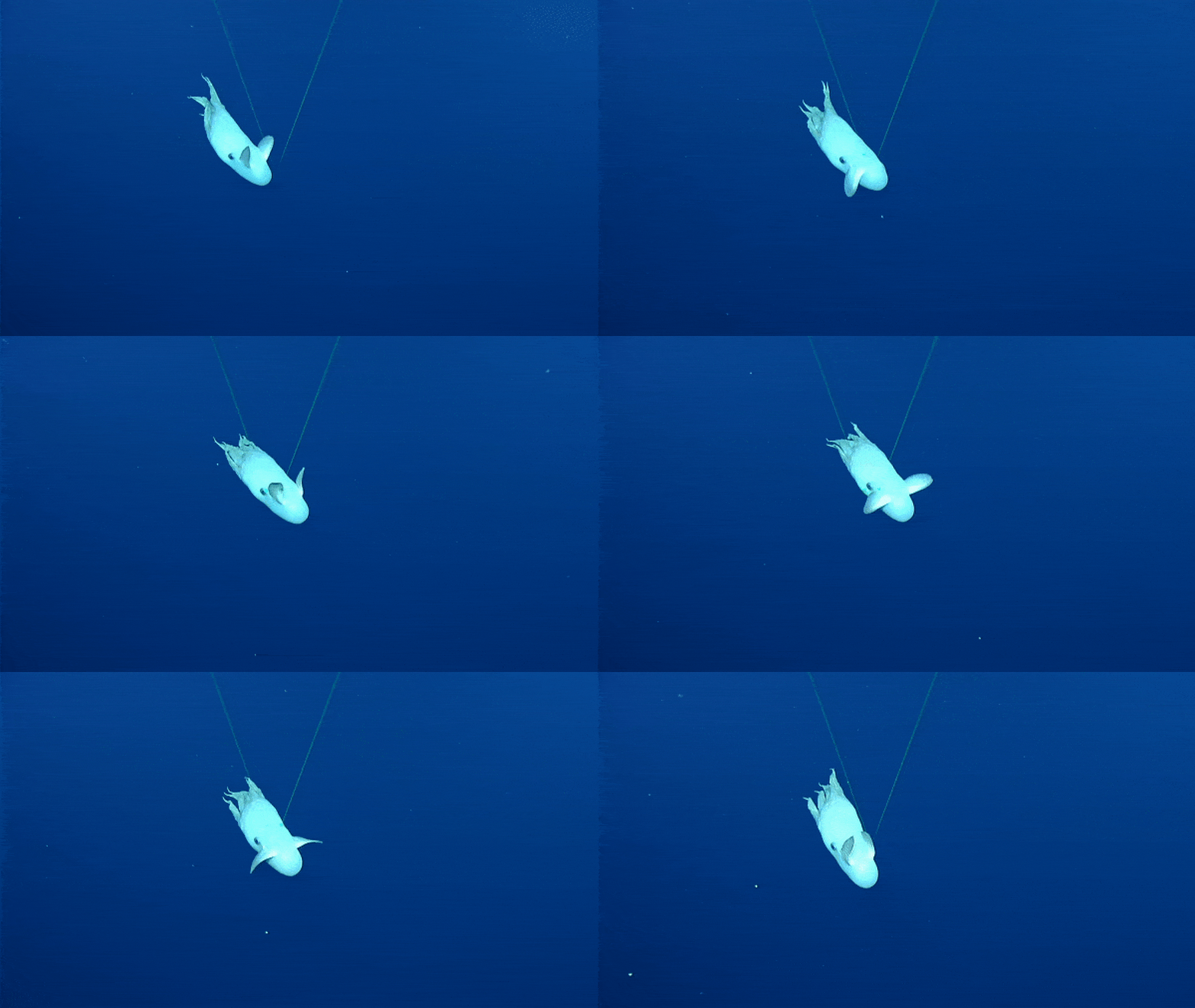
When researchers reviewing deep-sea footage noticed a pale, otherworldly figure drifting gracefully through the darkness, they understood immediately that they were witnessing something rare. The creature moved slowly, its body translucent against the blackness, propelled not by frantic motion but by gentle, rhythmic flaps that resembled wings more than fins. This was a dumbo octopus, one of the deep ocean’s most elusive inhabitants, captured on camera in extraordinary detail.
The footage stood out not just because of the animal’s appearance, but because dumbo octopuses are almost never seen alive, let alone filmed moving naturally in their environment. What scientists captured was not a fleeting glimpse, but a clear view of how this ghostly cephalopod swims through the crushing depths of the ocean. What follows is an exploration of why this sighting matters, how dumbo octopuses survive in one of Earth’s harshest environments, and what this rare moment reveals about life in the deep sea.
Meet the Dumbo Octopus, a Deep-Sea Phantom
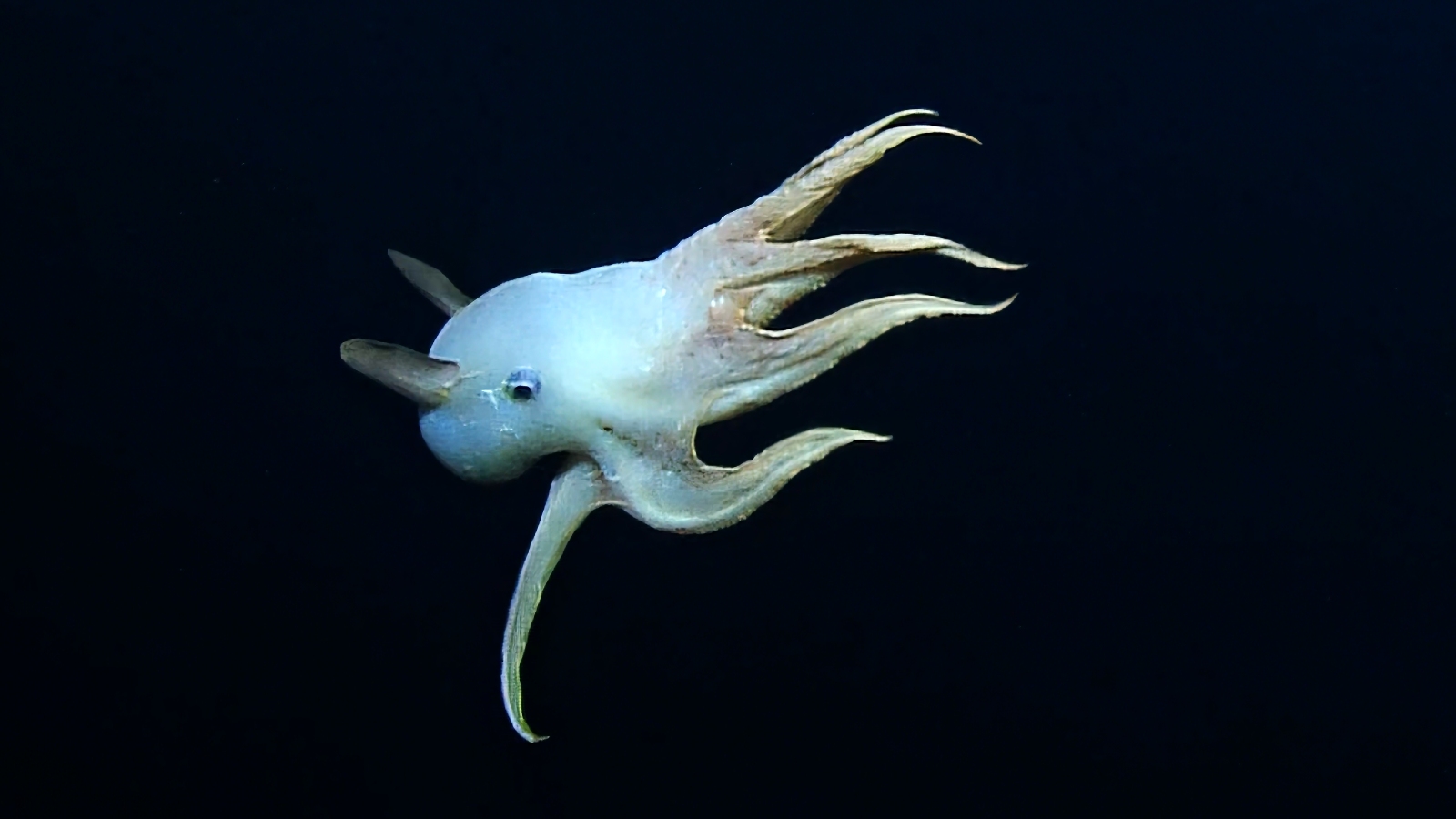
Dumbo octopuses belong to a group of octopuses known as cirrate octopods, distinguished by the ear-like fins that extend from either side of their heads. These fins give the animal its nickname, inspired by the Disney elephant Dumbo. Unlike their shallow-water relatives, dumbo octopuses live at extreme depths, often more than 3,000 meters below the surface.
In this realm, sunlight never penetrates, temperatures hover just above freezing, and pressure reaches levels that would instantly crush most living beings. Yet dumbo octopuses have adapted to thrive here, evolving bodies that are soft, flexible, and uniquely suited to life under immense pressure.
Why Dumbo Octopuses Are So Rarely Seen
The deep sea remains one of the least explored environments on the planet. Dumbo octopuses inhabit regions far beyond the reach of traditional diving equipment, making encounters exceptionally rare. Most knowledge of these animals comes from preserved specimens collected by deep-sea trawls, which offer limited insight into behavior.
Filming a dumbo octopus alive requires advanced remotely operated vehicles capable of descending thousands of meters, navigating rugged terrain, and capturing high-resolution footage in near-total darkness. Even with such technology, sightings are uncommon, as dumbo octopuses appear to be solitary and sparsely distributed across vast areas of the ocean floor.
The Moment the Dumbo Octopus Began to Swim
In the newly released footage, the dumbo octopus is seen rising gently from the seafloor, its fins moving in smooth, synchronized motions. Unlike many octopuses that rely on jet propulsion, dumbo octopuses primarily swim by flapping their fins, conserving energy in an environment where food is scarce.
The movement appears almost effortless, more like floating than swimming. Scientists note that this mode of locomotion minimizes disturbance to the surrounding water, an advantage in the deep sea where sudden movements could attract predators or waste precious energy.
Why Its Movement Fascinated Marine Biologists
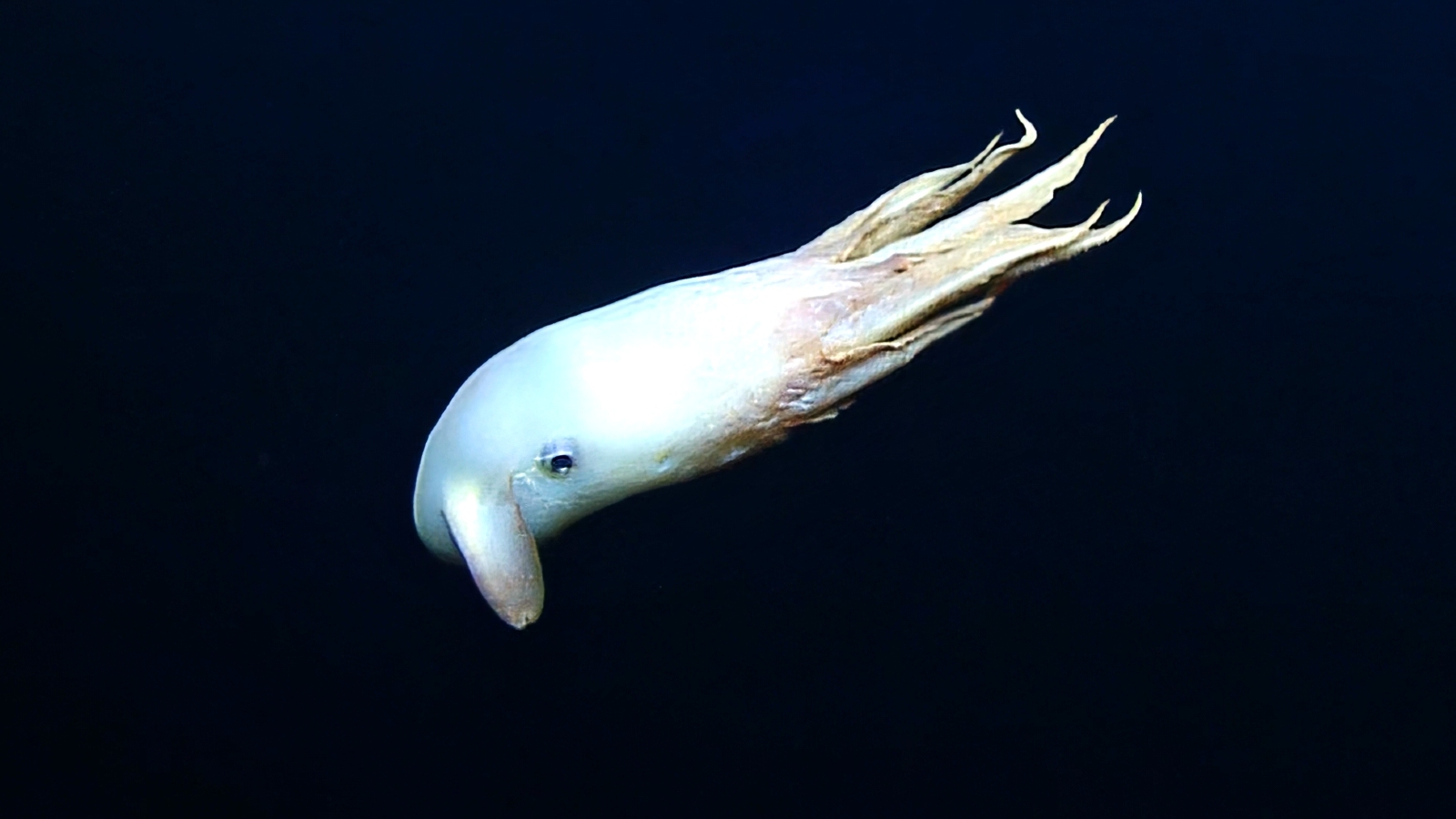
The footage provided rare confirmation of theories long held by scientists. Dumbo octopuses were believed to rely on fin-based swimming, but seeing the behavior in action offered new details about speed, posture, and coordination. The octopus maintained a steady orientation, its body held upright as it drifted through the water column.
This form of movement contrasts sharply with the frantic bursts seen in shallow-water octopuses. In the deep sea, efficiency is survival. Every motion must be deliberate, conserving energy while allowing the animal to navigate its environment with precision.
Life at Extreme Depths Requires Extraordinary Adaptations
Dumbo octopuses lack the ink sacs found in many other octopus species. In the pitch-black depths where they live, ink clouds would serve little purpose. Instead, they rely on camouflage, transparency, and subtle movement to avoid detection.
Their bodies are gelatinous, reducing density and allowing them to hover above the seafloor with minimal effort. This softness also helps them withstand immense pressure, as rigid structures would be vulnerable to collapse. These adaptations highlight how evolution shapes life in ways that defy surface-world expectations.
What Dumbo Octopuses Eat in the Deep Sea
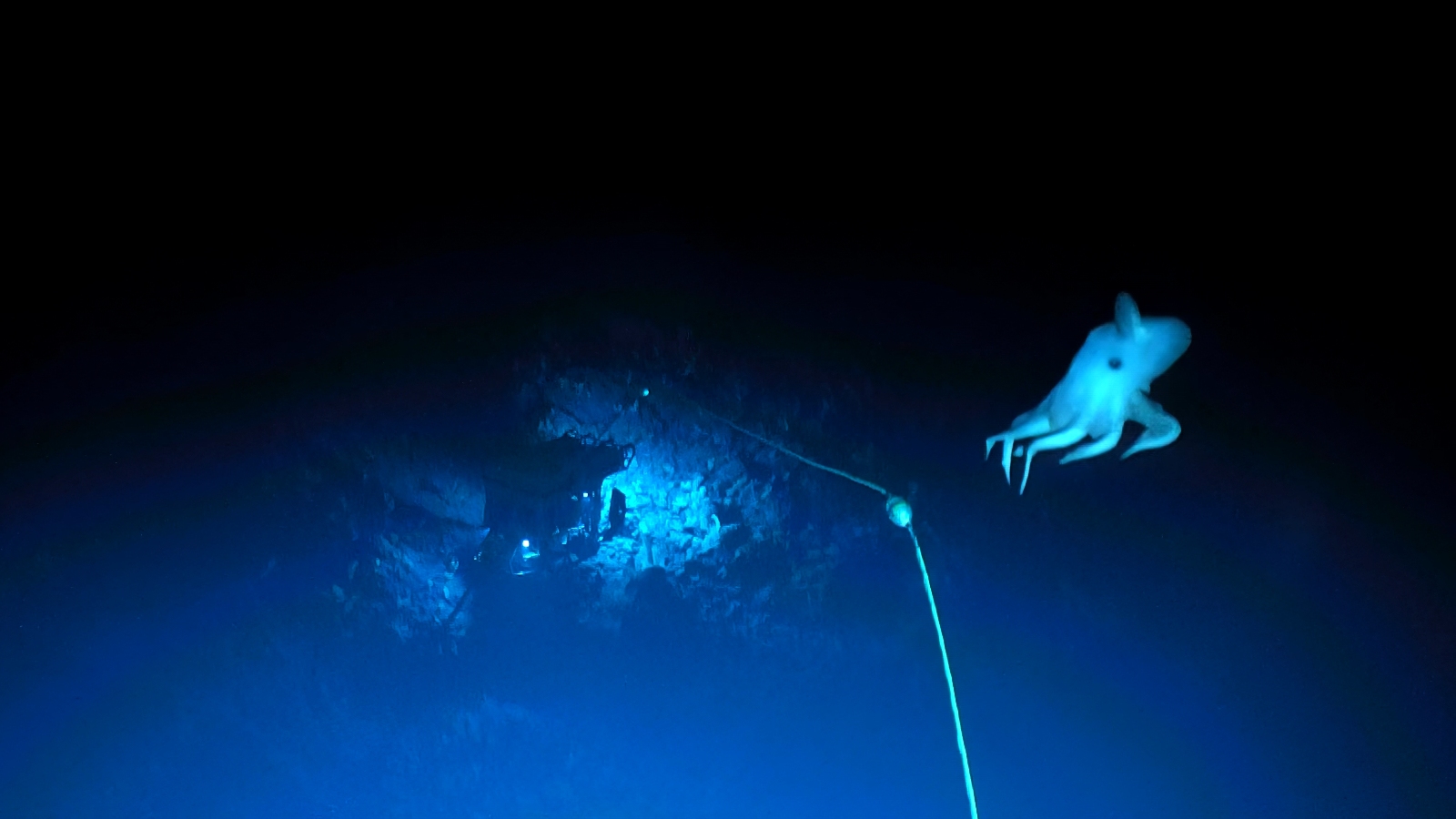
Food is scarce in the deep ocean, and dumbo octopuses have adapted accordingly. They feed primarily on small invertebrates such as worms, crustaceans, and copepods found on or just above the seafloor. Rather than grasping prey with speed, they use slow, deliberate movements to capture food.
Scientists believe dumbo octopuses often hover just above the sediment, scanning for movement. This feeding strategy aligns with their low-energy lifestyle, allowing them to survive where meals may be few and far between.
Why This Footage Matters to Science
Every observation of a living deep-sea creature adds valuable data to a field still filled with gaps. The footage of the dumbo octopus swimming provides insights into behavior that cannot be inferred from preserved specimens alone. It confirms assumptions about locomotion while raising new questions about how these animals interact with their environment.
Marine biologists emphasize that behavior is as important as anatomy when understanding a species. How an animal moves, feeds, and responds to stimuli reveals how it fits into its ecosystem. In the case of the dumbo octopus, these details help scientists better understand deep-sea food webs and ecological dynamics.
The Deep Sea Remains Earth’s Least Known Habitat
Despite covering most of the planet, the deep ocean remains largely unexplored. Scientists estimate that a significant percentage of deep-sea species have yet to be discovered, let alone studied in detail. Each expedition reveals new organisms, behaviors, and ecosystems that challenge existing knowledge.
The dumbo octopus footage is a reminder of how much remains hidden beneath the waves. Even well-known species can surprise researchers when observed in their natural habitat.
Why Deep-Sea Exploration Is Increasing
Advances in technology have made deep-sea exploration more feasible than ever before. High-definition cameras, improved lighting systems, and remotely operated vehicles allow scientists to venture deeper and stay longer in extreme environments.
As interest in deep-sea mining, climate research, and biodiversity grows, so does the urgency to document life in these regions. Understanding deep-sea ecosystems is essential for assessing the impact of human activity and protecting vulnerable species before they are threatened.
How Climate Change Could Affect Dumbo Octopuses
Although dumbo octopuses live far below the surface, they are not immune to the effects of climate change. Shifts in ocean temperature, chemistry, and circulation can influence food availability even at great depths. Changes in surface ecosystems can cascade downward, altering deep-sea environments in ways scientists are only beginning to understand.
Studying species like the dumbo octopus helps researchers monitor these changes. As indicators of deep-sea health, such creatures offer clues about broader oceanic shifts.
A Creature That Redefines Beauty in the Ocean
The dumbo octopus challenges traditional ideas of beauty and grace in marine life. Its pale body, oversized fins, and slow movements create an almost ethereal presence. Watching it swim feels less like observing an animal and more like witnessing a living apparition.
This aesthetic impact plays a subtle but important role in public engagement. Images and videos of deep-sea creatures capture imagination, fostering curiosity and support for ocean exploration and conservation.
Why Seeing It Alive Changes Everything
There is a profound difference between studying preserved specimens and observing a living creature in motion. The footage transforms the dumbo octopus from an abstract curiosity into a dynamic being, navigating its environment with purpose and grace.
For scientists and the public alike, such moments bridge the gap between data and wonder. They remind us that even in the most remote corners of the planet, life persists in forms both strange and beautiful.
What This Discovery Adds to Our Understanding of the Ocean
The rare footage of the dumbo octopus swimming enriches scientific understanding by filling in behavioral gaps. It demonstrates how adaptation, efficiency, and elegance converge in extreme environments. Each observation adds depth to our understanding of biodiversity and resilience.
As exploration continues, similar discoveries will likely reshape how scientists think about life at depth, revealing ecosystems that are complex, interconnected, and surprisingly fragile.
A Glimpse Into a World Still Largely Unseen
The dumbo octopus gliding through darkness is more than a captivating image. It is a glimpse into a world that remains largely unexplored, where countless species move silently beyond human awareness.
Moments like this remind us that discovery is ongoing. Even in an age of satellites and global mapping, vast realms remain unknown, waiting patiently beneath the waves.
Why This Footage Resonates Beyond Science
Beyond its scientific value, the footage resonates on a human level. It evokes awe, humility, and curiosity, emotions that have driven exploration throughout history. Seeing the dumbo octopus swim through the deep sea connects viewers to a planet that is still full of mystery.
In a time when much of the natural world feels increasingly familiar or threatened, such encounters offer a powerful reminder: Earth still holds secrets, and every glimpse brings us closer to understanding—and protecting—the life that shares it with us.
A Quiet Reminder From the Depths
As the dumbo octopus fades back into the darkness, the footage leaves a lasting impression. It speaks to the resilience of life, the limits of human knowledge, and the importance of continued exploration.
In the silent depths of the ocean, creatures like the dumbo octopus move unseen, carrying stories millions of years in the making. Capturing even a moment of their existence is not just a scientific achievement—it is a reminder of how much there is left to discover.