

You walk through the airport, belt off, shoes off, maybe even pat down-scanned—thinking the machines only pick up bombs or hidden blades.
But what if one of those machines could see much more than that? So much more, in fact, that airports had to scramble and replace them?
That’s exactly what happened—when the Transportation Security Administration (TSA) and U.S. airports realised their X-ray body scanners were capable of seeing far beyond what anybody expected.
Here’s the niche tech story with broad implications for your travel budget, your body, your privacy—and even your health.
Let’s dig in.
Table of Contents
- The machines that changed travel forever
- The moment of revelation: what they could really see
- Big change: airports press the reset button
- Why this matters for travel finance and the airport business
- Health + privacy: guidelines vs. what could happen
- Looking ahead: what travellers need to know
- What comes next for airport tech—and maybe for your next trip
- The big question for you
The machines that changed travel forever
Post-9/11 aviation security exploded: metal detectors weren’t enough, threats had become cleverer. Enter full-body scanners—machines meant to catch what metal detectors can’t.
Some of these scanners, built by companies like Rapiscan Systems, used back-scatter X-rays—a thin beam across the body to detect hidden items.
In effect: instead of a cartoon outline, you got a very detailed image. That’s when things got messy.
Because what started as “detecting hidden weapons” turned into “we can see more than we ever intended to”.
The moment of revelation: what they could really see
It was soon discovered that these machines weren’t just capturing the outlines of concealed threats—they were giving operators detailed views, effectively of naked bodies.
Travellers got uneasy. Privacy advocates sounded alarms. Health experts questioned radiation. The optics (literally and figuratively) weren’t good.
Think for a moment: if you discovered a machine at your bank cleared security with a scan that showed far more of you than required—would you accept that? Would you trust the institution using it?
Faced with the backlash, many U.S. airports began replacing or removing those scanners. One article pointed out:
“U.S. airports were forced to change the security scanners they used after it was revealed just how much the x-rays showed up.”
The TSA announced they would phase out models that didn’t meet new standards—namely machines that offered Auto Target Recognition (ATR) software that displayed generic body outlines instead of detailed human images.
So what seemed like “upgrade for security” became “redo for privacy and safety”.
Why this matters for travel finance and the airport business
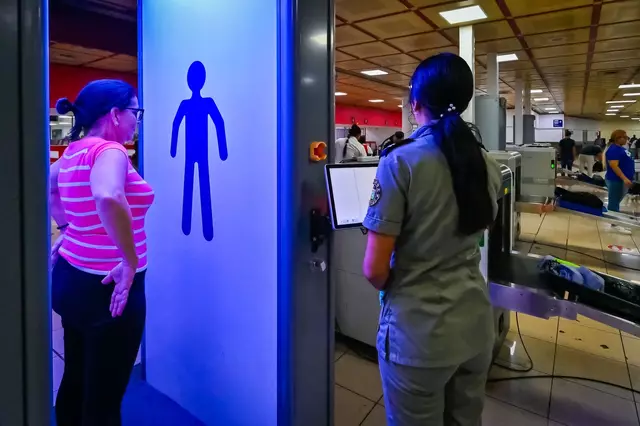
Here’s where the story widens out: this is more than privacy theatre—it affects budgets, operations and travel costs.
- These scanners cost hundreds of thousands of dollars each. One source cited ~US $180,000 per unit for some Rapiscan machines.
- Replacing or upgrading them means airports (and by extension taxpayers and airlines) incur extra capital costs.
- That can trickle down: maintenance fees, risk-mitigation upgrades, staffing changes—all adding to the cost of doing business.
- For you, the traveller, that might mean higher ticket fees, longer lines, more “what’s allowed” confusion or even increased insurance premiums for airlines.
In short: what seems like “just tech in the background” affects your travel wallet.
Health + privacy: guidelines vs. what could happen
From the health side: X-ray scanners emit ionizing radiation—even if very small—and back-scatter machines were criticised for that.
Privacy: having an image that’s effectively a nude outline is uncomfortable for many, especially vulnerable groups.
And the new machines? They aimed to reduce radiation and show only a generic silhouette via ATR software, not a nude image.
But it raises questions: if a device scans you so deeply, even if labelled “generic silhouette”, what safeguards protect you? Are operators trusted? Is data retained? Who sees it?
If you were in that security queue, would you question the machine—or just let it go?
Looking ahead: what travellers need to know
So what should you keep in mind next time you fly—or plan to fly?
- Ask about the scanner type: Some airports still use older tech; some use newer, more privacy-friendly ATR systems.
- Expect extra time: Because older machines or optional upgrades mean slower throughput.
- Budget for the cost of “security”: Bigger fees might stem from more advanced screening equipment or additional staffing.
- Protect your privacy: Wear modest clothing if you’re uneasy. Ask for alternative screening if available.
- Health awareness: If you’re particularly sensitive to radiation (pregnant, small children)—check your airport’s tech or ask for alternative screening.
And remember: the next time you walk through security, you’re not just passing a gate—you’re stepping through a process shaped by tech, finance, regulation, and personal rights.
But we’re not done yet.
What comes next for airport tech—and maybe for your next trip
The evolution of airport scanning doesn’t stop here. Consider:
- AI and machine-learning algorithms that replace human reviewers, speeding up lines—but maybe raising new privacy flags.
- Multi-use scanners used for different threats, meaning higher cost but broader coverage (including health screening, e.g., detecting elevated body temperature).
- Regulatory changes: as concerns grow about data and images, laws may demand more transparency and less invasive tech.
Which means your ticket fee, waiting time and even destination choices might hinge on the screening tech in use.
But what if this kind of scanning spreads beyond airports? Into stadiums, malls or public buildings?
And if it does—how comfortable are you with that level of visibility?
The big question for you

Next time you stand in that airport security line, ask yourself:
“Am I stepping into the future of travel—or into a machine that sees too much?”
Would you fight for the “right” machine, or just accept the hassle and move on?
Because as travellers, we’re not just buying a flight—we’re buying trust in systems we never see. And those systems are shifting.
What will you choose: speed or privacy? Cost or comfort?