
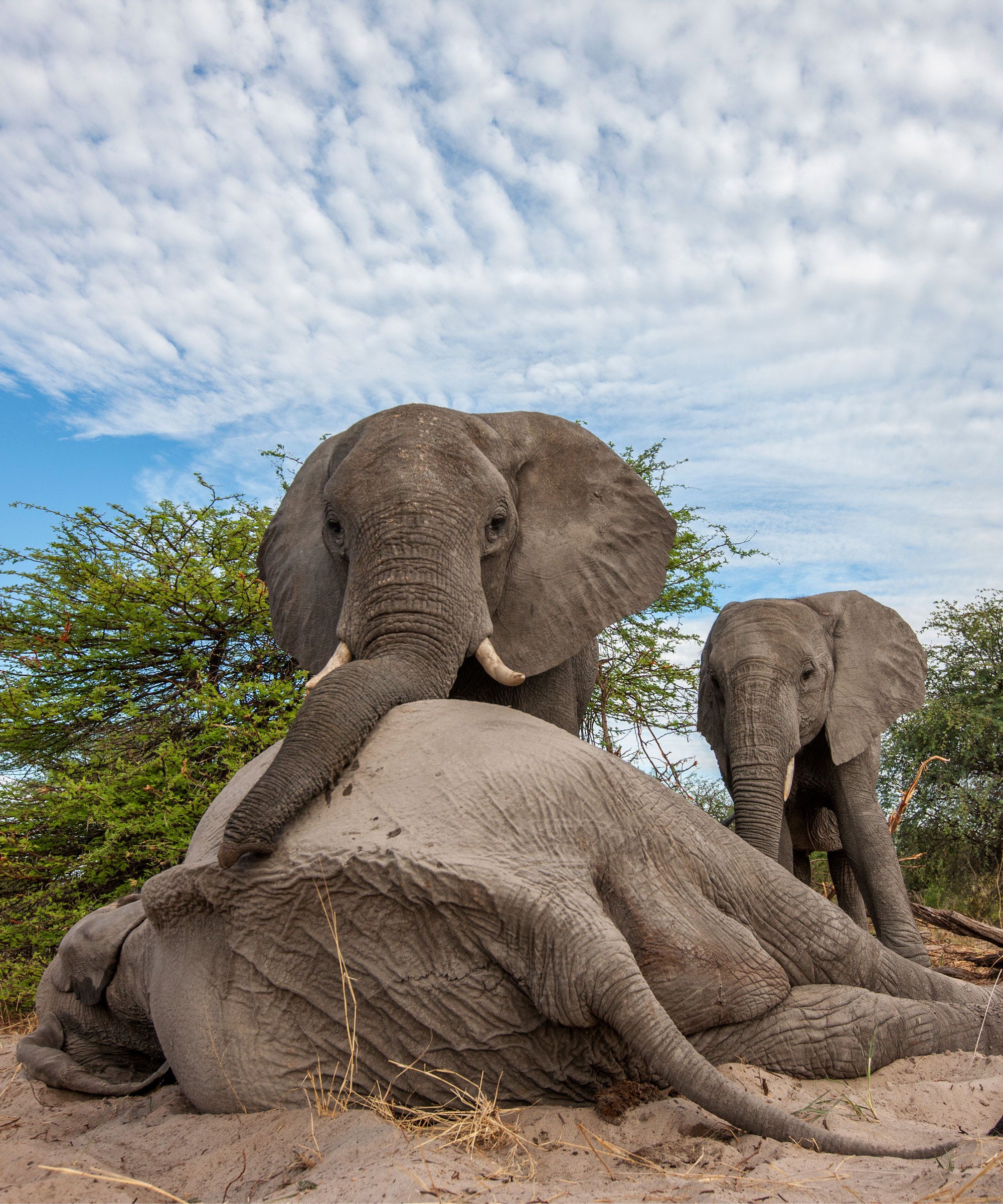
It begins with a quiet place in the African savanna.
Tall grass swaying.
Wind humming through the acacia trees.
And a circle of enormous grey shadows standing perfectly still.
Not predators.
Not hunters.
Not guardians.
Elephants.
Gathered around bones.
Touching them gently — with trunks that shake, linger, and sometimes tremble.
For years, people have whispered stories about elephants mourning their dead.
Now, scientists say those whispered stories may be true.
And the truth is far more emotional, more humanlike, and more spiritually profound than we ever believed.
Table of Contents
- The First Moment Scientists Knew Something Was Different
- The Ritual: What Elephants Do When They Meet the Dead
- What Makes Elephant Mourning So Strange — and So Human
- The Role of Memory: How Elephants Never Forget Their Own
- A Mother’s Grief: The Hardest Behavior to Watch
- What Elephant Mourning Teaches Us About Ourselves
- Climate Change: How a Warming Planet Affects Elephant Mourning Rituals
- Travel and Tourism: Why This Research Changes How We See Safaris
- Home Improvement & Lifestyle Trends: The Unexpected Ripple Effect
- Conservation: Why Understanding Elephant Grief Helps Us Protect Them
- A Final Image: The Herd That Wouldn’t Leave
- Final Reflection: What Does Elephant Mourning Say About Us?
The First Moment Scientists Knew Something Was Different
Researchers observing elephant herds noticed something strange:
Elephants don’t just pass by skeletons.
They stop.
They gather.
They touch.
They feel.
But most shocking of all —
they behave differently around elephant bones compared to any other animal bones.
They avoid zebra skulls.
They ignore buffalo remains.
They walk past giraffe skeletons.
But when they find an elephant skull?
Everything changes.
Why?
Is it memory?
Emotion?
Recognition?
Or a kind of ritual we still don’t understand?
Scientists kept watching — and what they discovered shook the world of animal behavior.
The Ritual: What Elephants Do When They Meet the Dead
Elephants approach carcasses slowly, quietly — unlike their usual bold movements.
They stretch their trunks toward the bones.
They run their trunk tips along tusks and jaws as if reading a story carved from time.
They lift bones gently.
They smell them.
They caress them.
No aggression.
No fear.
Just… reverence.
Almost as if they are saying hello.
Or goodbye.
Or both.
And what happens next is even more stunning.
Some elephants return to the same skeleton year after year —
even long after it has been bleached by the sun.
What draws them back?
Love?
Memory?
Something deeper?
What Makes Elephant Mourning So Strange — and So Human

Scientists studying elephant emotion discovered behaviors that look hauntingly familiar:
- standing in silence for long periods
- touching the body repeatedly
- remaining near a carcass for hours or days
- low rumbling vocalizations — similar to grieving sounds
- younger elephants imitating adults’ mourning behavior
- herds changing travel routes to revisit burial sites
Elephants aren’t just reacting.
They’re remembering.
And memory is everything.
One scientist said:
“Elephants treat their dead like we treat ours — with recognition, emotion, and time.”
Think about that.
An animal weighing several tons…
with a brain capable of complex empathy…
showing grief that mirrors human sorrow.
It forces us to ask:
If elephants mourn like us,
do they also love like us?
The Role of Memory: How Elephants Never Forget Their Own
You’ve heard the saying: elephants never forget.
Science shows it’s true.
Elephants remember:
- faces
- voices
- locations
- water holes
- migration paths
- family members, even years later
The memory circuits in an elephant’s brain are massive —
far larger than those of most mammals.
So when they find bones of an elephant who died years ago,
they may actually recognize them.
Not by sight.
But by smell.
Elephant trunks have 40,000 muscle units —
able to detect chemical signatures we can’t even imagine.
When they inhale the scent of an old skeleton,
they may be inhaling memories.
Maybe even family.
A Mother’s Grief: The Hardest Behavior to Watch
The most heartbreaking behavior of all comes from elephant mothers.
When a baby dies, the mother refuses to leave the body.
She nudges it.
Lifts it.
Tries to wake it.
She may carry or drag the baby for miles.
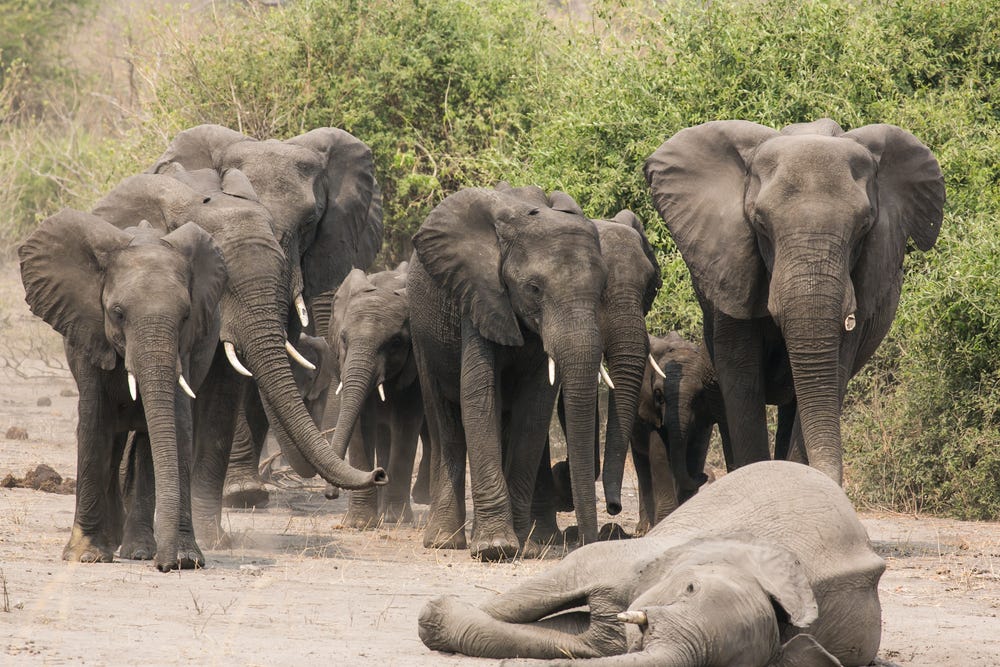
Other females — aunties, sisters, grandmothers — gather around her in silence.
Some place their trunks on her back.
Some stay beside her for days.
Some watch over the body while the mother rests.
One field researcher said:
“It was like watching a funeral.”
Grief isn’t just a human emotion.
It’s a living, breathing force in the animal world.
And elephants feel it deeply.
What Elephant Mourning Teaches Us About Ourselves

Here’s where the story reaches beyond wildlife and into our own lives.
Watching elephants mourn forces us to confront questions humans have wrestled with for centuries:
- What does it mean to remember?
- What does it mean to love?
- What does it mean to lose?
- Do rituals exist beyond humanity?
- Are we really the only species that honors its dead?
The answer, increasingly, is no.
And if elephants carry grief —
they also carry wisdom.
Wisdom about family.
Wisdom about loyalty.
Wisdom about the connections we often forget to cherish.
Climate Change: How a Warming Planet Affects Elephant Mourning Rituals
This part is often overlooked but vital.
As climate change reshapes the African savanna:
- droughts intensify
- water sources shrink
- elephant pathways change
- herds move faster and farther
This disrupts their rituals.
Imagine wanting to return to a loved one’s resting place —
but the land has changed, the water is gone,
and survival demands movement instead of memory.
Climate shifts don’t just take lives.
They take traditions.
And that loss may alter elephant culture forever.
Travel and Tourism: Why This Research Changes How We See Safaris
Travelers who witness elephant mourning describe it as life-changing.
Ethical safari companies now incorporate educational experiences around:
- elephant communication
- herd structure
- emotional behavior
- conservation threats
This transforms safari trips from “animal sightseeing”
into deeply human, deeply ethical experiences.
Travelers don’t just go home with photos.
They go home transformed.
And travel companies know it —
which is why ethical wildlife tours are now one of the fastest-growing eco-travel markets.
Home Improvement & Lifestyle Trends: The Unexpected Ripple Effect
You might not expect elephant research to influence home design —
but it does.
As wildlife conservation becomes a core cultural value, homeowners invest in:
- nature-inspired décor
- earth-tone palettes
- eco-friendly materials
- sustainable gardens
- wildlife-themed art
- mindfulness spaces
Elephant-inspired spaces — symbolizing wisdom, memory, family —
have become a rising interior trend.
Because elephants don’t just teach us about animals.
They teach us about home.
Conservation: Why Understanding Elephant Grief Helps Us Protect Them
When the public sees elephants as emotional beings —
not tourist attractions —
support for conservation skyrockets.
Funding increases.
Sanctuary tourism rises.
Anti-poaching efforts strengthen.
Laws gain traction.
Because protecting a creature who feels grief
is different from protecting a creature who simply exists.
One inspires sympathy.
The other inspires responsibility.
A Final Image: The Herd That Wouldn’t Leave
Researchers once documented a moment that says everything:
A matriarch died.
Her herd surrounded her.
They touched her body.
They stood vigil.
They rumbled deep sounds scientists believe were emotional calls.
When they finally walked away,
a teenager stayed behind.
She refused to leave…
long after the rest had gone.
She returned four times that week.
Not because she had to.
But because she remembered.
Final Reflection: What Does Elephant Mourning Say About Us?
Imagine you’re standing on the savanna.
An elephant herd approaches a skeleton.
They reach out.
They touch.
They feel.
No words.
No funerals.
No language.
Just connection.
If these giants mourn their dead —
if they remember, honor, and love —
then grief isn’t just a human experience.
It’s a universal one.
And maybe that means something powerful:
We are not alone in our emotions.
We share the planet with beings whose hearts echo our own.
So the real question becomes:
If elephants can honor their dead…
can we honor their lives?