

The moment she walked past the alley, she heard it —
a sound so faint, so desperate, it could have easily been lost in the wind.
A tiny whimper.
A plea.
A cry for help.
Most people would have kept walking.
Most wouldn’t have even noticed.
But she stopped.
And because she stopped, a life that had been forgotten… would finally be seen.
Table of Contents
- The Crate Hidden in the Shadows
- A Desperate Rescue Begins
- The Drive That Felt Like Forever
- At the Vet: A brutal assessment
- The First Signs of Healing
- A New Home — With New Challenges
- Pet Wellness & Finance: The Hidden Cost of Saving a Life
- Home Improvement: Creating a Safe Space for a Traumatized Dog
- Travel & Lifestyle: The Unexpected Joy
- The Transformation: From Crate to Courage
- Final Reflection: What Would You Have Done?
The Crate Hidden in the Shadows
It wasn’t the kind of crate you use to transport a pet.
It was small, old, filthy, and zip-tied shut —
hidden behind trash cans, as if someone hoped no one would ever find it.
Inside?
A tiny soul curled into a trembling ball.
When she knelt beside the crate, she saw two eyes staring back —
wide, terrified, begging for someone, anyone, to care.
This wasn’t confinement.
It was imprisonment.
The air was hot.
The puppy’s breathing was rapid.
And every single second mattered.
What would you do in that moment?
Freeze?
Cry?
Or break the crate open with your bare hands?
A Desperate Rescue Begins
Her heart raced.
She pulled at the zip ties — too tight.
She grabbed keys, twisting, forcing the metal through the plastic.
Her hands shook.
The puppy cried louder.
With one final twist, the crate popped open.
And the little dog collapsed into her arms.
He wasn’t just scared.
He was dehydrated, starving, and weak from exhaustion.
His ribs pressed through his skin.
His fur was matted.
His paws were raw.
It didn’t take a vet to see the truth:
He had been suffering for a long time.
But now he had someone who refused to walk away.
The Drive That Felt Like Forever
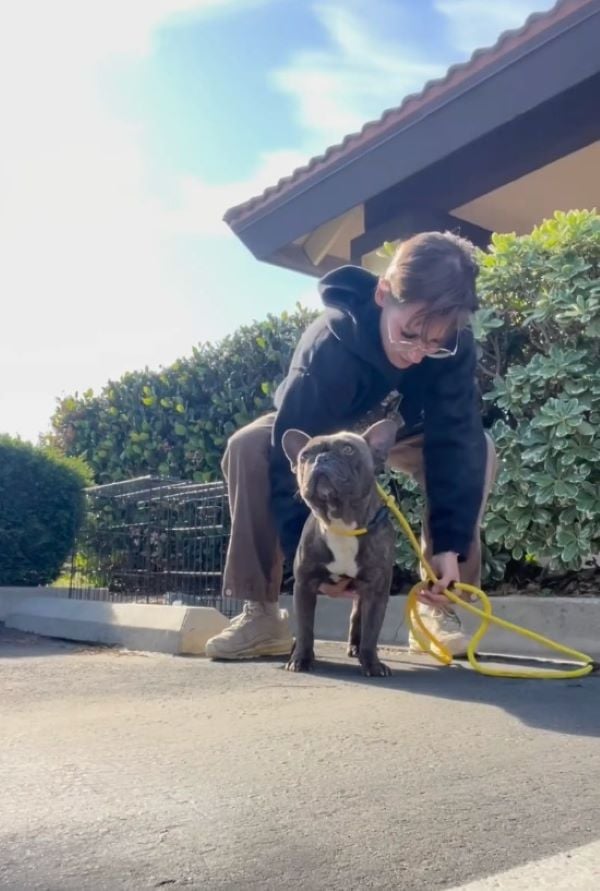
She wrapped him in her jacket and ran to her car.
Air conditioning on full blast.
A bowl of water carefully tilted toward him.
Soft reassurances whispered over and over:
“You’re safe now.”
“You’re okay.”
“I’ve got you.”
He tried to wag his tail —
just a tiny movement, but enough to break her heart.
The drive to the vet was only 12 minutes.
But it felt like 12 hours.
Because when you’re racing against time,
minutes feel like miles.
At the Vet: A brutal assessment
The clinic staff rushed him inside.
They ran tests.
They checked his temperature.
They examined his injuries.
They hydrated him with IV fluids.
And their conclusion was heartbreaking:
“He’s been neglected for weeks.
Possibly months.”
He was malnourished.
His stomach was empty.
His muscles were severely weakened.
He had infections starting in both ears.
His body was shutting down from stress and dehydration.
But the most painful damage wasn’t physical.
It was emotional.
He had been abandoned — intentionally.
Yet he still clung to hope.
Why do animals trust so freely…
even after being betrayed?
The First Signs of Healing
That night, she stayed with him at the clinic.
He slept curled against her,
as if terrified she might disappear too.
Over the next few days:
- His appetite slowly returned.
- His tail wagged a little more each morning.
- His eyes began to shine instead of tremble.
- His tiny body regained strength.
- His spirit — once crushed — began to rise again.
And every small improvement felt like witnessing a miracle.
But healing wasn’t going to be simple.
Dogs who experience confinement trauma often struggle with:
- separation anxiety
- fear of crates or small spaces
- loud noises
- shadows
- abandonment panic
- difficulty trusting humans
She was determined to help him through each one.
Because she hadn’t rescued him by accident.
She believed she was meant to find him.
A New Home — With New Challenges

When he was finally healthy enough to leave the clinic, she made a decision:
She wasn’t just rescuing him.
She was adopting him.
But the transition wasn’t easy.
The first time she left the room?
He cried.
The first time she closed a door?
He shook.
The first time he saw a crate — even an open one?
He hid behind the couch for nearly an hour.
But love can rewire a broken heart.
And slowly…
He learned:
- A home is safe.
- A bed is soft.
- A meal will always come.
- Hands can be gentle.
- Humans can be kind.
And for the first time, he slept with his body fully relaxed —
not curled in fear.
Pet Wellness & Finance: The Hidden Cost of Saving a Life
Rescue stories tug at the heart…
but they also tug at the wallet.
She faced real expenses:
- emergency vet fees
- antibiotics
- IV fluids
- grooming
- follow-up visits
- proper nutrition
- behavioral support
Many people underestimate the financial responsibility of a neglected dog.
That’s why experts recommend:
- emergency pet funds
- pet insurance
- pet wellness savings accounts
- budgeting for vet bills and nutrition
Because a second chance requires commitment — emotional and financial.
But in her words:
“Every dollar felt like an investment in his future.”
Home Improvement: Creating a Safe Space for a Traumatized Dog
A dog who spent his early life in a crate needs an environment that feels open, free, predictable, and comforting.
She redesigned her home:
- installed baby gates instead of crates
- created a “safe corner” with blankets
- opened blinds for natural light
- added soft rugs for comfort
- placed water bowls in multiple rooms
- used calming diffusers
- pet-proofed cables and furniture
Her home didn’t just change for him —
it changed because of him.
And research shows that when people redesign their home around pets, overall wellbeing improves:
- lower stress
- better routine
- more movement
- safer environments
- stronger emotional connection
A rescued pet transforms a home just as much as a home transforms a pet.
Travel & Lifestyle: The Unexpected Joy

He became her companion — in the car, on hikes, in parks, at cafés.
But new experiences were challenging.
The first time he felt wind out the window?
He froze.
Then… slowly… closed his eyes in peace.
The first time he stepped on grass?
He lifted his paws in confusion.
Then ran back and forth, wild with joy.
The first time he slept without trembling?
She cried.
These moments remind us:
Freedom is a gift animals never stop appreciating.
And seeing life through the eyes of a once-trapped soul
can teach us more about gratitude than any human ever could.
The Transformation: From Crate to Courage
Now?
He’s unrecognizable.
His fur is soft and clean.
His eyes are bright and trusting.
His body is strong.
His tail is unstoppable.
His heart is whole again.
He plays.
He cuddles.
He explores.
He loves.
And he finally knows —
without a doubt —
that he will never be trapped again.
His transformation proves something powerful:
Trauma doesn’t define a life.
Hope does.
Final Reflection: What Would You Have Done?
Imagine walking past that crate.
No labels.
No signs.
No owner.
No explanation.
Just a tiny soul begging for someone to help.
Would you have stopped?
Would you have opened the crate?
Would you have cared enough to change everything?
Because she did.
And that single choice didn’t just save a life —
it reshaped one.
Every rescue story begins the same way:
With someone willing to stop.
And someone else praying for exactly that.