

When news broke that researchers in Japan had built a wearable robotic tail designed to help humans regain balance the way animals do, the internet reacted the only way it knows how: equal parts fascination, disbelief, and a sudden urge to imagine what it would feel like to have a functional tail attached to your waist. But behind the sci-fi visuals is a serious engineering idea—one that sits at the crossroads of aging societies, workplace safety, rehabilitation, and the future of wearable assistive tech. The device, developed by a team at Keio University in Tokyo, is known as Arque, and it’s meant to stabilize the body by moving in the opposite direction of a person’s sway, shifting momentum and center of gravity in real time.
What follows is an exploration of how a “tail” moved from evolutionary history into modern laboratories, why its physics are surprisingly sensible, and what it suggests about the next decade of human-centered wearable technology—where help may not come as a cane or a brace, but as an entirely new appendage that thinks in counter-movements.
Table of Contents
- A Tail for Humans Sounds Absurd—Until You Remember What Tails Actually Do
- Meet Arque, the Biomimicry-Inspired Tail Built to Swing Against Your Sway
- The Physics Behind It Is Simple: Counter-Momentum and Center of Gravity
- Why Seahorses Inspired a Human Tail
- How It Moves: Artificial Muscles and an External Air System
- The Team Behind It and the Bigger Question They’re Asking
- Why This Matters for an Aging Society—and Not Just as a Tech Curiosity
- Beyond Healthcare: Warehouse Work, Heavy Loads, and Industrial Stability
- The Unexpected Use Case: Virtual Reality and “Physical Storytelling”
- Why It’s Not “Coming Soon”: Speed, Comfort, and Long-Term Effects
- What a Robotic Tail Really Represents: A Preview of Extra-Limb Wearables
- The Real Question Isn’t “Would You Wear It?”—It’s “Who Will Need It First?”
- What This Could Mean in Five to Ten Years
- Conclusion: A Strange Shape, a Serious Signal
A Tail for Humans Sounds Absurd—Until You Remember What Tails Actually Do
In nature, tails aren’t costume accessories. For many animals, tails are tools that manage balance, agility, and rapid shifts in motion. Cheetahs use tail movements to stay stable while changing direction at speed. Other vertebrates use their tails as an added “limb” that supports movement and posture. The Keio team began by looking at this exact role: tails as a mechanical solution to the constant problem of staying upright when the body’s center of mass is in motion.
The premise is almost embarrassingly straightforward. When a human leans to the left, the body’s momentum and weight distribution drift left. If a tail swings right at the correct time, it can counter that drift—nudging the body back toward stability. In other words, the tail doesn’t need to be strong enough to “hold you up.” It needs to be smart enough to pull your momentum back toward center before you lose control.
Meet Arque, the Biomimicry-Inspired Tail Built to Swing Against Your Sway
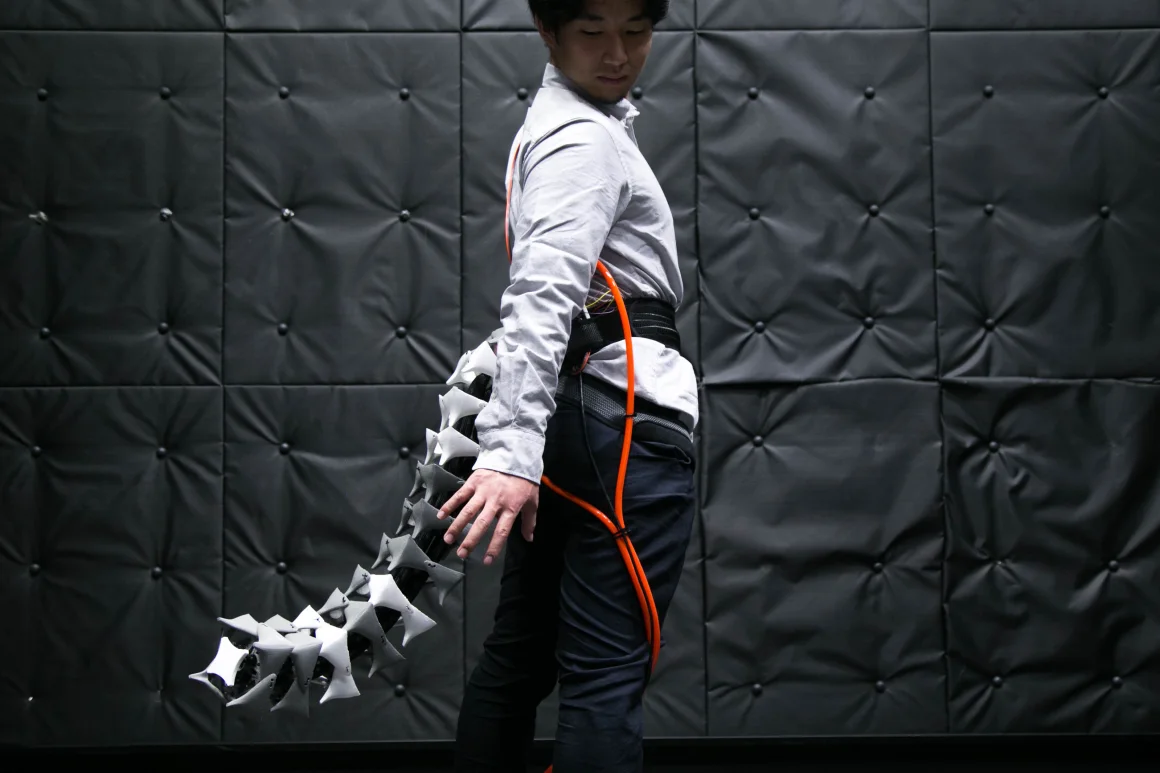
Arque is described as a thick, roughly one-meter wearable tail that straps to the waist using a harness, with an exterior that resembles a segmented spine—plates that look “vertebrae-like,” reinforcing the illusion that it’s alive even though it’s entirely mechanical.
Its most important feature is not the look—it’s the response. Arque uses sensors and a set of artificial “muscles” so it can move as the wearer moves. Lean left, and the tail swings right. Lean forward, and the tail lifts upward. The goal is to create a corrective counter-movement that changes the body’s momentum, subtly guiding the wearer back into balance.
This is why the invention is easy to laugh at but hard to dismiss. It translates a real biological function into wearable engineering: a stabilizer that acts like a moving pendulum attached to your core.
The Physics Behind It Is Simple: Counter-Momentum and Center of Gravity
Arque’s balancing concept relies on a principle you can feel even without equations. When you carry a heavy bag on one side, you naturally shift your torso to compensate. When you trip, your arms shoot out to correct your center of gravity. These are instinctive counterbalances.
Arque automates a version of that instinct, but instead of using arms, it uses a tail-like mass that can swing into position. By moving opposite to the wearer’s lean, it generates enough force to influence overall body momentum and help re-center balance.
The fascinating part is how “small” the motion can be while still making a difference. The tail doesn’t need to shove a person across a room. It only needs to contribute a timely nudge to prevent a wobble from escalating into a fall.
Why Seahorses Inspired a Human Tail
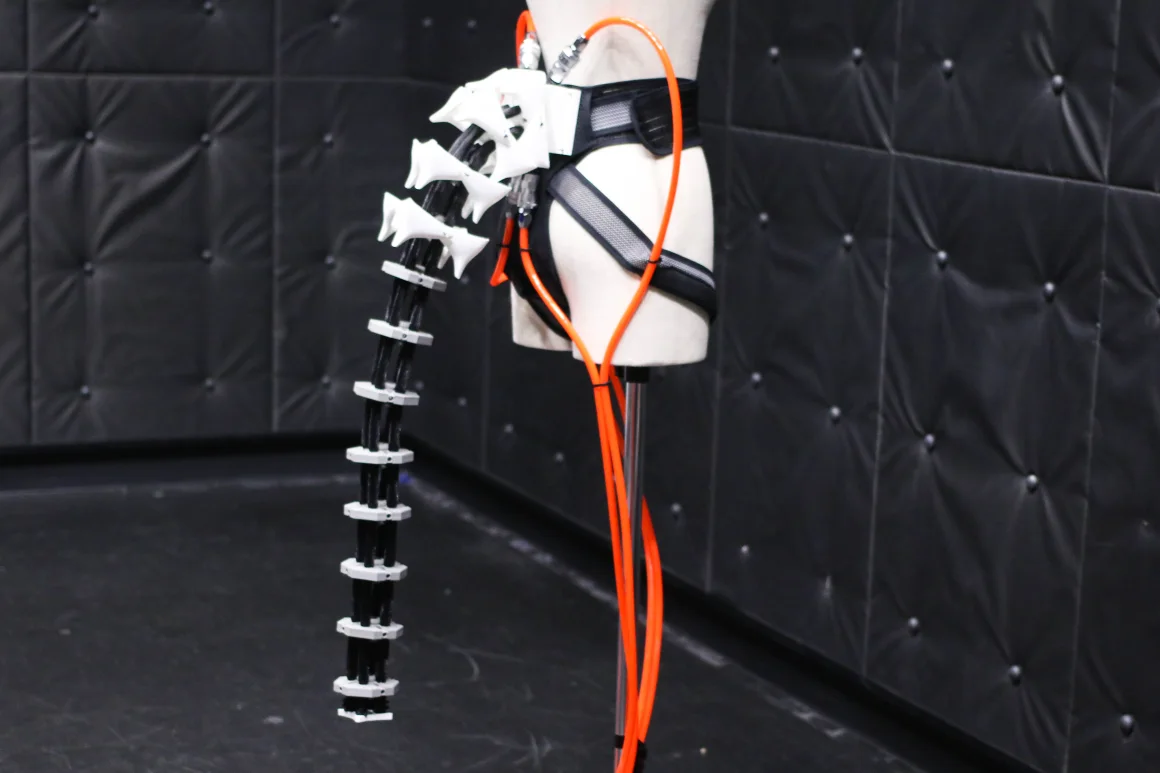
The Keio team didn’t begin with seahorses. Early prototypes reportedly experimented with cat and tiger tail concepts, but those designs proved too light to create the needed effect. The shift came when the researchers turned to seahorses—whose tails are larger relative to body form and structurally robust, offering the “heavier” design logic needed for meaningful counterbalance.
This detail matters because it reveals the design challenge at the heart of Arque: a balancing tail must be heavy enough to matter, but wearable enough to tolerate. The team has described a rough target that the tail should represent around 5% of the wearer’s body weight to be effective, with the prototype’s length and weight adjustable accordingly.
That is a surprisingly practical statement. It suggests Arque isn’t meant to be a one-size-fits-all gadget. It’s meant to be tuned like an assistive device—calibrated to the person wearing it.
How It Moves: Artificial Muscles and an External Air System
Arque’s motion is powered by artificial “muscles.” Reports describe four artificial muscles enabling movement in multiple directions, and compressed air is used as part of the actuation approach in at least one account of the system’s operation.
This choice has immediate consequences. The device is still largely in the research-and-development phase, and its reliance on an external pressurized air system underscores why it is not yet a consumer product you’ll see on shelves. Fast Company notes the system resembles a larger external apparatus and that the setup limits mobility in its current form.
In other words, Arque is not trying to be fashionable today. It is trying to prove the underlying concept: that a wearable counterbalancing appendage can stabilize the human body in a repeatable, measurable way.
The Team Behind It and the Bigger Question They’re Asking

Arque has been linked to Keio University’s Graduate School of Media Design, and reporting names researchers including Yamen Saraiji, Junichi Nabeshima, and Kouta Minamizawa as part of the project leadership and public explanation of its goals.
One quote-driven theme emerges consistently: the project is not just about preventing falls. It’s about asking what it means to “empower the human body with wearable technologies.”
That question is where Arque becomes bigger than a tail. It becomes a test case for wearable augmentation—technology that doesn’t simply protect the body, but adds new behaviors to it.
Why This Matters for an Aging Society—and Not Just as a Tech Curiosity
One of the most grounded motivations for Arque is its potential value for older adults and people with balance disorders. Falls are a major risk factor for injury, loss of independence, and long-term health decline. A device that subtly reduces instability could have significant quality-of-life benefits—if it is safe, socially acceptable, and comfortable enough for real use.
Several reports emphasize this direction explicitly, connecting Arque to the goal of supporting elderly mobility, and framing it as part of a broader push in Japan to use technology to help an aging population stay active.
Yet the invention also suggests an uncomfortable truth: balance support tools often come with stigma. Canes, walkers, and braces are effective—but they visibly mark the user as needing help. A robotic tail might not remove stigma; it might simply replace one kind of attention with another. That social factor could matter as much as the engineering.
Beyond Healthcare: Warehouse Work, Heavy Loads, and Industrial Stability
Arque’s most immediate “non-medical” case is workplace support. If a worker needs to carry heavy loads, instability can lead to falls, injuries, or damaged goods. The tail concept offers an alternative: a stabilizer that helps the body stay centered during lifting or fast motion.
Both KSL’s CNN-attributed write-up and Reuters-linked coverage point to industrial potential, including assisting workers handling heavy objects or loads.
This is where the tail becomes less whimsical. In warehouses and logistics environments, stability is performance. A small reduction in wobble could translate to fewer accidents and less fatigue—if the device can be made light, portable, and unobtrusive.
The Unexpected Use Case: Virtual Reality and “Physical Storytelling”
Then there is the most surreal but strangely logical application: entertainment and VR. If your virtual environment shows a strong wind pushing you, a balancing appendage could apply a counterforce that makes your body feel that push—creating more immersive haptic feedback.
This idea has been explicitly discussed in reporting: the tail could intentionally destabilize a user to match a virtual scenario, turning balance control into a storytelling tool.
It’s an inversion of the assistive mission, and it’s revealing. The same technology that keeps you upright could also make you feel simulated forces more realistically. That dual purpose—safety and sensation—often drives innovation in wearables, because entertainment markets can sometimes fund advances that later benefit health applications.
Why It’s Not “Coming Soon”: Speed, Comfort, and Long-Term Effects
Researchers have emphasized that Arque remains in development and is not expected to be available soon, with ongoing work aimed at improving responsiveness—such as adding more artificial muscles so it reacts faster—and investigating possible side effects from long-term use.
This caution is essential. A device that actively moves your center of gravity can’t be treated like a novelty. If the timing is wrong, it could worsen balance instead of improving it. If the motion pattern conflicts with how a person naturally corrects their posture, it could increase fatigue or strain.
And there is a deeper question: if you wear a device that “does balance for you,” does your own balance system become less practiced over time, or does it train you toward better stability? That’s the kind of question that separates a clever prototype from a truly helpful assistive technology.
What a Robotic Tail Really Represents: A Preview of Extra-Limb Wearables
Arque is not the first attempt to give humans additional wearable “limbs,” and coverage notes Keio researchers have explored other wearable limb concepts and systems that expand bodily capability.
But the tail is uniquely symbolic because it taps into a missing piece of human evolution. Humans don’t have tails—yet tails solve a problem humans still face: dynamic stability. Arque suggests that the future of wearables may not always look like discreet smartwatches or hidden sensors. Some of it may look like anatomy we never had, built from modular segments and controlled by responsive artificial muscles.
That may sound like science fiction, but the logic is almost mundane: if nature already solved the physics, engineers can borrow the solution.
The Real Question Isn’t “Would You Wear It?”—It’s “Who Will Need It First?”
It’s easy to frame Arque as a meme. Would you wear a tail in public? Would your friends laugh? Would it make you feel like a character in a game?
But the more important question is who might benefit from it in ways that actually change daily life: older adults with instability, people with balance disorders, workers in physical jobs, patients in rehabilitation, and eventually anyone in a world where wearable technology becomes as normal as glasses.
Arque also forces a new kind of design conversation. If assistive devices become more visibly “augmented,” society will need a new etiquette of empathy—one that treats unusual wearables not as spectacle, but as support.
What This Could Mean in Five to Ten Years
Even the researchers themselves have framed the tail as a glimpse into the near future of wearable technology, asking what human bodies might look like with wearable tech in the next five to ten years.
The likely path forward is not a sudden invasion of robotic tails into daily life. It’s incremental progress: smaller actuation systems, improved responsiveness, better comfort, reduced stigma through design, and clinical research that clarifies who benefits and how.
If those hurdles are solved, the tail could become something surprisingly ordinary—a tool you strap on when you need a bit more stability, the way you wear a back brace for lifting or a knee support for running. And if that happens, Arque will be remembered not as a weird headline, but as one of the early prototypes that made “extra-limb wearables” feel inevitable.
Conclusion: A Strange Shape, a Serious Signal
A wearable robotic tail may look like a gimmick, but Arque’s real power is that it makes a complex idea instantly understandable: balance can be assisted by intelligent counter-movement. The device represents biomimicry at its most literal—borrowing anatomy’s solution to physics.
Whether Arque becomes a mainstream assistive tool or remains a research milestone, it already does something important. It expands the imagination of what wearable tech can be—moving beyond tracking and monitoring into physical transformation, where technology doesn’t just measure the body, but actively helps the body move through the world.