
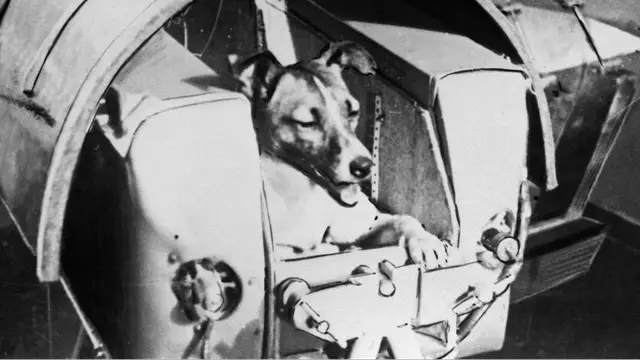
Laika wasn’t born in a laboratory.
She wasn’t bred for experiments or trained in some elite facility.
She was simply a stray — one of thousands wandering the streets of Soviet-era Moscow, scavenging for food among garbage bins and warming herself beside building vents.
Scientists purposely looked for such dogs.
Street dogs were:
- resilient
- resourceful
- used to harsh weather
- accustomed to noise
- small and lightweight
In other words, perfect candidates for space.
Laika was chosen because she was calm, friendly, and didn’t bark aggressively. One scientist said:
“She was quiet and charming. A very good dog.”
But behind her gentle nature lay a destiny that would shake the world.
Table of Contents
- The Space Race: A Planet Divided, A Mission Accelerated
- The Training: From Dusty Pavements to Space Simulations
- The Launch: A Hero Sent Into the Unknown
- The World Reacts — Glory, Grief, and Unanswered Questions
- What Really Happened in Orbit — The Secret Revealed Years Later
- But Laika Changed Space Travel Forever
- Humanity Reflects — And Never Forgets Her
- A Stray Who Touched the Stars — And Millions of Hearts
- Why Laika’s Story Still Matters Today — More Than Ever
- Before You Go: A Question to Think About
The Space Race: A Planet Divided, A Mission Accelerated
In the 1950s, the United States and the Soviet Union were locked in the Space Race, pushing for technological dominance.
Sputnik 1 had just been launched — the first man-made satellite.
The world was stunned.
To prove that the USSR was advancing even faster, Premier Nikita Khrushchev demanded another launch within one month.
Something bigger.
Something historic.
Something that would force the world to pay attention.
A living creature.
And so the search for a dog who could become a symbol of Soviet scientific achievement began.
Laika, unaware of the global politics unfolding overhead, would soon be lifted from the streets into a brutal training program.
The Training: From Dusty Pavements to Space Simulations
Laika and two other strays were brought into a research center.
What awaited them was intense:
- tiny cages that severely restricted movement
- simulations of rocket vibrations
- exposure to extreme temperatures
- confinement for long periods
- medical procedures and sensors implanted
It wasn’t training for survival.
It was training for endurance in the face of the unimaginable.
Scientists later admitted:
Laika was never meant to return alive.
The technology to bring a spacecraft back from orbit didn’t yet exist.
Think about that:
A living soul was chosen for a journey with no return ticket.
Would you still call it progress… or sacrifice?
The Launch: A Hero Sent Into the Unknown
On November 3, 1957, Laika was placed inside Sputnik 2, secured to her tiny cabin by harnesses, barely able to move.
As the rocket engines ignited, sensors showed her heart racing far above normal levels — fear, confusion, and sheer terror.
And then…
Weightlessness.
Silence.
Darkness.
Laika became the first animal in history to orbit Earth.
A homeless dog from the streets of Moscow was now circling the planet at 18,000 mph — something no human had done before.
The World Reacts — Glory, Grief, and Unanswered Questions
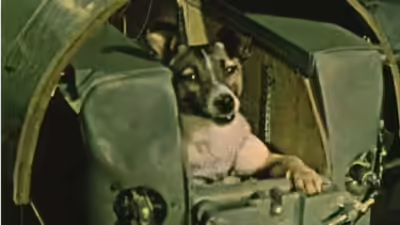
The Soviet Union celebrated.
Propaganda hailed Laika as a hero, a symbol of courage serving her country.
The world was captivated.
Newspapers from New York to Tokyo featured her image.
But soon, troubling questions emerged:
- How long would she survive?
- Would she feel pain?
- Was she suffering?
- Why was she sent if she couldn’t return?
Animal welfare groups protested.
Scientists debated ethics.
Even children wrote letters begging for her safe return.
But the truth was far worse than anyone knew.
What Really Happened in Orbit — The Secret Revealed Years Later
Soviet officials originally claimed Laika lived several days and was euthanized painlessly.
That was a lie.
Decades later, documents revealed the truth:
Laika died within hours due to overheating and stress after a failure in the thermal control system.
She died scared, confused, and alone.
One scientist later said, with heartbreaking honesty:
“We did not learn enough from the mission to justify the death of the dog.”
Another admitted:
“I ask forgiveness from her, and we humans should all ask forgiveness.”
It took 45 years for the truth to be told.
But Laika Changed Space Travel Forever
Despite the tragedy, Laika’s mission contributed to human space exploration in ways few people realize:
✔️ helped develop life-support systems
✔️ provided data on surviving launch conditions
✔️ advanced spacecraft temperature control research
✔️ paved the way for human orbits
✔️ influenced engineering designs for future missions
Without Laika, Yuri Gagarin — the first human in space — might never have flown safely.
Laika’s mission taught scientists what not to do, as much as what to do.
Her sacrifice shaped space history.
But at what cost?
Humanity Reflects — And Never Forgets Her
Today, Laika is honored worldwide:
- statues
- memorial plaques
- murals
- books
- documentaries
- museum exhibits
She has become a symbol of:
- courage
- innocence
- sacrifice
- the moral cost of scientific ambition
Her story inspires discussions about ethical science, animal welfare, and the responsibility humans carry when exploring the unknown.
Space agencies now follow strict policies regarding animals and testing — policies that exist because of Laika.
A Stray Who Touched the Stars — And Millions of Hearts
Laika never returned to Earth, but her story does something powerful:
It forces us to pause.
To recognize that behind every scientific breakthrough lies a story — sometimes heroic, sometimes heartbreaking.
Laika didn’t volunteer.
She didn’t choose to be a pioneer.
But she became one.
A dog who once had no name became one of the most famous names in history.
And today, when we look at the night sky, some people still whisper:
“Goodnight, Laika.”
Why Laika’s Story Still Matters Today — More Than Ever
In an age of rapid technology, AI breakthroughs, space tourism, and billion-dollar rockets — Laika reminds us of something timeless:
Progress without compassion is not true progress.
Her mission forces us to think bigger:
- What are we willing to sacrifice for innovation?
- How do we measure the true cost of scientific discovery?
- Who gets to decide what’s “worth it”?
Laika’s story isn’t just about the past — it’s a mirror held up to our future.
Before You Go: A Question to Think About

If you had been one of the scientists in 1957 —
knowing what Laika would face…
Would you still send her?
Or would you fight to protect her?
That question stays with you.
And maybe that’s why Laika still matters —
not because of how she died,
but because of how deeply she made the world feel.