

Table of Contents
- The Push for a Federal Voter ID Law
- Arguments in Favor of Nationwide Voter ID Laws
- Reinforcing Election Integrity
- Consistency Across State Lines
- Arguments Against Nationwide Voter ID Laws
- Potential Voter Disenfranchisement
- State Authority and Legal Challenges
- State‑Level Action and the Broader Picture
- Political Stakes Ahead of the Midterms
- Public Opinion and Trust in Elections
- Potential Legal and Logistical Barriers
- Looking Ahead to the 2026 Midterms and Beyond
- Final Reflection: Balancing Integrity and Access
The Push for a Federal Voter ID Law
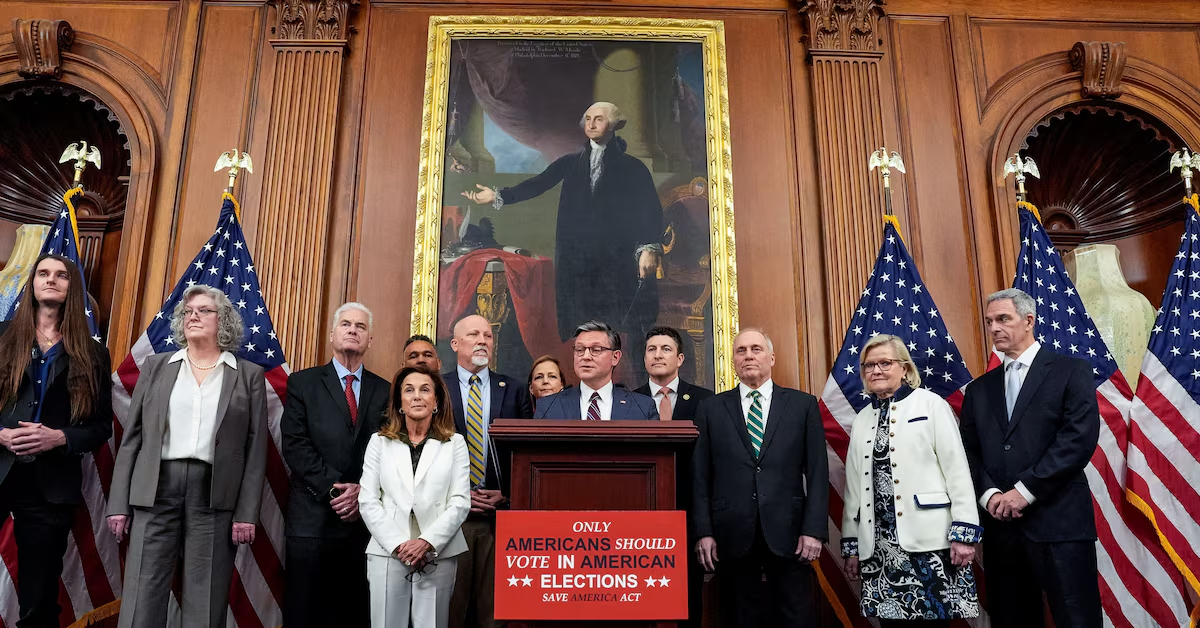
At the heart of the nationwide voter ID debate is a bill known as the Safeguard American Voter Eligibility Act, sometimes referred to in its updated form as the SAVE America Act. This legislation would require voters in federal elections to present government‑issued identification and documentary proof of U.S. citizenship when registering and casting ballots. It would also require states to remove noncitizens from voter rolls and implement new verification procedures before elections.
Proponents — led prominently by former President Donald Trump and many Republican lawmakers — argue that a national standard is necessary to protect election integrity and guard against voter fraud, even though documented cases of widespread fraud are extremely rare. They contend that without uniform requirements, discrepancies between state systems can erode public confidence and create confusion about voter eligibility.
Trump and his allies have repeatedly said that the GOP cannot win elections without tougher voting rules, and they have demanded that Congress pass the voter ID bill before signing any new legislation. Some Republicans have even suggested using procedural tactics like budget reconciliation — normally reserved for budgetary legislation — to bypass the Senate filibuster and enact the law with a simple majority.
Arguments in Favor of Nationwide Voter ID Laws
Reinforcing Election Integrity
Supporters say that requiring official photo ID and proof of citizenship can strengthen voter confidence in election outcomes. In a political climate where many Americans express worry that elections are unfair or vulnerable to fraud, a uniform national standard could reassure voters that only eligible citizens are casting ballots.
This argument also ties into broader GOP messaging that election reforms are necessary to prevent irregularities and ensure that every legal vote counts. Advocates point to public opinion polls that show broad support for voter ID requirements across party lines, suggesting that many Americans see identification checks as common‑sense protections.
Consistency Across State Lines
A national law could simplify election administration by creating a single standard for all federal elections, rather than relying on a patchwork of state rules. This would make it easier for citizens who move frequently or live near borders between states with widely varying requirements. States already handle voter ID differently, with some requiring photo ID and others having no requirement at all.
Proponents argue that national uniformity could reduce confusion among voters and election officials alike, making the system more predictable and easier to enforce.
Arguments Against Nationwide Voter ID Laws
Potential Voter Disenfranchisement
Critics of a federal voter ID standard warn that such laws could create unnecessary barriers for eligible voters, particularly among low‑income citizens, elderly Americans, and racial and ethnic minorities who may lack photo ID or difficulty obtaining documents like passports or birth certificates. Research has found that millions of voting‑age citizens do not possess documentary proof of citizenship, and requiring such proof could suppress participation among communities already underrepresented at the polls.
Democrats and voting rights advocates also highlight historical examples where similar laws have been used — or alleged to be used — as tools for voter suppression rather than genuine election protection. A strict federal voter ID law might exacerbate these concerns by imposing a one‑size‑fits‑all requirement that does not account for regional inequalities in access to documentation or transportation to obtain IDs.
State Authority and Legal Challenges

Another key point of contention is constitutional authority. Under the U.S. Constitution, states traditionally control the mechanics of elections within their borders. While Congress does have the power to regulate federal elections, opponents worry that federal mandates could overstep and reduce state flexibility, leading to costly legal challenges and confusion in ballot administration.
Several legal experts have questioned whether nationwide voter ID requirements — particularly ones that override state procedures — would withstand judicial scrutiny, and critics argue that federal standards could be struck down or blocked by courts before they take effect.
State‑Level Action and the Broader Picture
Even as Congress debates national standards, individual states are moving forward with their own voter ID and election reforms. For example, constitutional amendments requiring voter ID are slated to appear on ballots in several states during the midterms, including initiatives in North Carolina and Nevada that would require photo identification at the polls.
These state‑level efforts reflect ongoing public engagement with election rules, and supporters argue that local action allows communities to tailor requirements to their specific needs rather than deferring to a broad federal mandate.
However, critics contend that a multitude of varying state rules complicates the national election landscape and can create inequities in voter access. They argue that modern mobility and the interconnected nature of the U.S. electorate call for more cohesive standards, not disjointed rules that differ dramatically from state to state.
Political Stakes Ahead of the Midterms
The debate over nationwide voter ID laws is closely tied to the 2026 midterm elections, which will determine control of Congress and shape the final two years of the presidential term. Republicans believe that stricter voting rules could mobilize their base and reduce turnout among segments of the electorate that tend to favor Democrats, who generally oppose widespread voter ID mandates.
Democrats, on the other hand, view federal voter ID laws as unnecessary and potentially harmful to voter participation. They argue that existing state laws and federal protections already provide sufficient safeguards against fraud, and that further restrictions do more harm than good. This stark division has made negotiations over the SAVE America Act — a proposed federal voter ID law — exceptionally contentious, with little sign of bipartisan compromise in sight.
Public Opinion and Trust in Elections
Americans remain deeply divided over the issue. Polling suggests many support some form of voter ID requirement, but there is much less consensus on how strict such policies should be or whether they ought to be imposed nationally. At the same time, confidence in election fairness has declined to historically low levels in recent years, creating pressure on leaders to demonstrate they are protecting the democratic process.
This decline in trust makes the debate more urgent, as lawmakers and political actors seek to reassure voters that elections are both secure and inclusive. Nationwide voter ID laws are often pitched as a solution — but whether they would actually boost trust or further polarize public opinion is a key question in the debate.
Potential Legal and Logistical Barriers
Even if Congress were to pass a national voter ID law before the midterms, implementing it in time would pose significant logistical challenges. States would need to update election systems, educate voters about new requirements, and potentially expand access to IDs — all while managing the regular demands of election preparation. These practical hurdles could slow voter participation or create confusion on Election Day.
Legal challenges could also delay implementation, with civil rights groups ready to sue over any provisions they view as discriminatory. Courts have previously struck down voter ID laws in some states for placing undue burdens on voters, a dynamic that could resurface at the federal level.
Looking Ahead to the 2026 Midterms and Beyond
The debate over nationwide voter ID laws reflects the deep polarization in American politics and the competing visions for the future of U.S. democracy. On one side are those who believe federal standards could build confidence in election outcomes and prevent fraud, while on the other are those who fear such laws could limit access and undermine participation. With the midterm elections approaching, this issue will remain central to national political discourse and legislative strategy.
Whether Congress ultimately passes a nationwide voter ID law before November 2026 — and whether it survives legal challenges — could shape not only voter experiences in that election but also the long‑term trajectory of election law in the United States. How lawmakers balance concerns about security, access, and democratic participation will influence debates over election reforms for years to come.
Final Reflection: Balancing Integrity and Access
The question of whether Congress should pass nationwide voter ID laws before the 2026 midterms is not merely a legislative issue — it strikes at the core of how Americans understand their democracy. It forces the nation to weigh trust in electoral outcomes against the imperative of ensuring broad and equal access to the ballot for all citizens. Amid deep political divisions and differing regional priorities, finding common ground on this issue remains one of the most complex challenges facing U.S. policymakers today — and the outcome will reverberate far beyond 2026.