
Table of Contents
- When a Floating Giant Appeared in the Ocean, the World Took Notice
- The Growing Crisis Hidden Beneath the Waves
- Why Traditional Cleanup Efforts Have Fallen Short
- The Dutch Engineering Philosophy Behind the Machine
- How the Plastic-Collecting “Monster” Actually Works
- Early Results That Changed the Conversation
- Environmental Impact and Ethical Considerations
- What This Innovation Means for Global Pollution Efforts
- 9. The Limits of Technology and the Need for Prevention
- Why This Floating Giant Represents More Than a Machine
When a Floating Giant Appeared in the Ocean, the World Took Notice
When images emerged of a massive floating structure stretching across open water, many people assumed it was another offshore platform or experimental vessel. But as details became clear, it was evident that this machine had a far more ambitious purpose. Dutch engineers had built what some now call a “monster” of marine engineering, a system designed not to roam the ocean like a ship, but to sit patiently and swallow plastic waste drifting with the currents.
The appearance of this structure marked a pivotal moment in the global fight against ocean pollution. Rather than focusing solely on cleaning beaches or banning single-use plastics, the project aimed directly at the problem accumulating far from shore. It was not just a machine, but a statement that large-scale solutions were finally being attempted at the scale the crisis demands.
The Growing Crisis Hidden Beneath the Waves

Plastic pollution has become one of the defining environmental challenges of the modern era. Every year, millions of tons of plastic enter the ocean, carried by rivers, wind, and poorly managed waste systems. Once there, the material does not simply disappear. It fragments into smaller pieces, spreading across vast distances and infiltrating marine ecosystems at every level.
The most alarming aspect of this pollution is its persistence. Plastic can survive in the ocean for centuries, breaking down into microplastics that are nearly impossible to remove. These particles are consumed by fish, birds, and eventually humans, creating a cycle of contamination that is still not fully understood. Against this backdrop, incremental solutions have begun to feel inadequate.
Why Traditional Cleanup Efforts Have Fallen Short
For years, cleanup efforts focused on coastal areas where plastic is most visible. Volunteers collected trash from beaches, and governments invested in waste management infrastructure. While these actions are essential, they address symptoms rather than the core accumulation zones offshore.
The open ocean presents unique challenges. The sheer scale, depth, and movement of water make conventional cleanup methods inefficient or impossible. Nets risk harming marine life, while ships consume enormous fuel resources for relatively small returns. What was missing was a system that could harness the ocean’s own movement rather than fight against it.
The Dutch Engineering Philosophy Behind the Machine

Dutch engineers are no strangers to large-scale water management. A country shaped by its relationship with the sea, the Netherlands has centuries of experience designing systems that control, redirect, and coexist with water. This cultural and technical heritage played a crucial role in the development of the ocean-cleaning machine.
Rather than chasing plastic through the ocean, the engineers designed a passive system. The structure uses long floating barriers that guide plastic waste toward a central collection point, allowing natural currents to do most of the work. This approach minimizes energy consumption and reduces disruption to marine life, aligning engineering precision with ecological sensitivity.
How the Plastic-Collecting “Monster” Actually Works
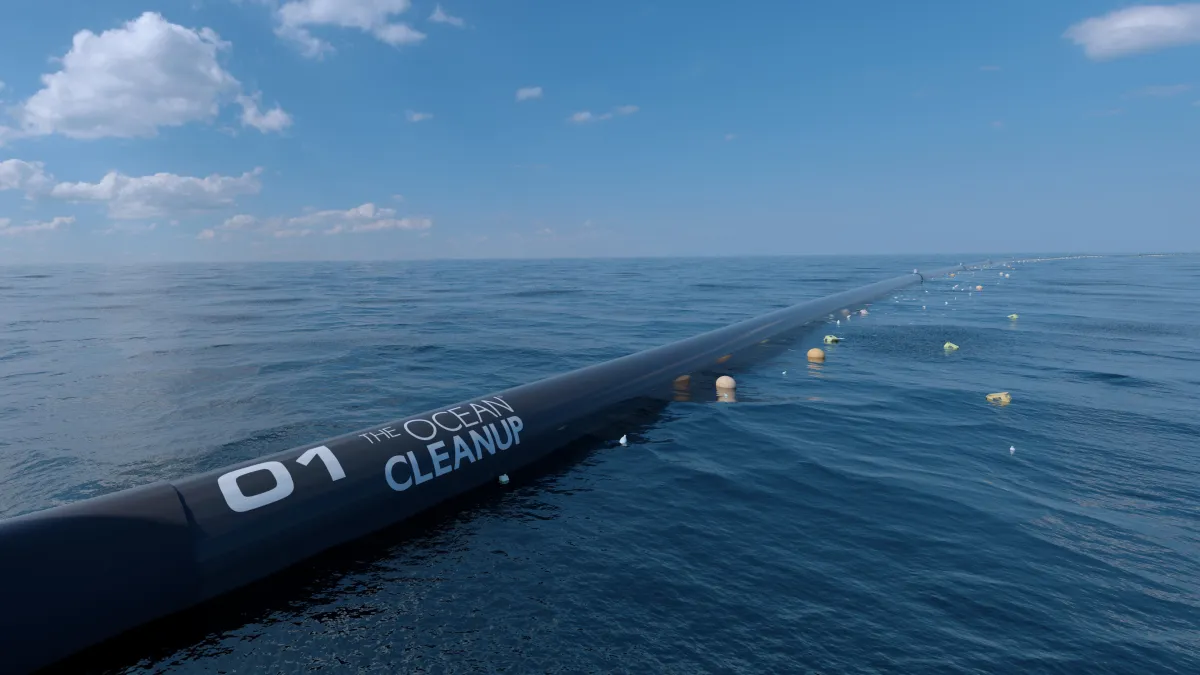
At first glance, the machine’s size is what captures attention. Stretching hundreds of meters, it forms a wide arc on the ocean’s surface. Beneath that simple shape lies a carefully calculated design. The floating arms extend just below the surface, deep enough to catch plastic debris but shallow enough to allow fish and other organisms to pass underneath.
As currents move through the structure, plastic naturally accumulates at the center, where it can be collected and transported for recycling or disposal. The system does not rely on engines or propulsion. Instead, it drifts at a carefully controlled speed, staying aligned with the flow of debris while minimizing stress on its components.
Early Results That Changed the Conversation
Initial deployments of the system were met with skepticism. Critics questioned whether such a large structure could survive harsh ocean conditions or collect plastic efficiently enough to justify its cost. Early tests revealed mechanical challenges, including stress fractures and material fatigue, forcing engineers to revise their designs.
Over time, those refinements paid off. Updated versions demonstrated improved durability and higher collection rates, capturing tons of plastic that would otherwise continue circulating through marine ecosystems. These results transformed public perception, shifting the conversation from whether the concept was possible to how quickly it could be scaled.
Environmental Impact and Ethical Considerations
Any intervention at this scale raises important questions about unintended consequences. Marine biologists closely monitored deployments to ensure that the system did not trap animals or disrupt migration patterns. So far, evidence suggests that the passive design significantly reduces harm compared to traditional net-based methods.
Still, engineers and environmentalists alike emphasize that cleanup is only one part of the solution. Removing plastic from the ocean does not stop new waste from entering. The machine is not a license to pollute, but a tool to buy time while broader systemic changes take effect.
What This Innovation Means for Global Pollution Efforts
The success of the Dutch system has implications far beyond a single project. It demonstrates that large-scale environmental engineering is not only possible, but potentially effective when guided by careful design and long-term thinking. Other countries and organizations are now exploring similar approaches tailored to different oceanic conditions.
The project also reframes the role of engineers in environmental debates. Rather than being seen as contributors to industrial damage, engineers are increasingly positioned as key problem-solvers capable of addressing the consequences of past mistakes.
9. The Limits of Technology and the Need for Prevention
Despite its promise, the machine cannot solve the plastic crisis on its own. The volume of plastic already in the ocean is immense, and new waste continues to flow in daily. Even with multiple systems operating simultaneously, cleanup efforts would struggle to keep pace without significant reductions at the source.
This reality underscores the importance of prevention. Policy reforms, improved waste management, and changes in consumer behavior remain essential. The ocean-cleaning machine serves as a powerful complement to these efforts, not a replacement for them.
Why This Floating Giant Represents More Than a Machine
Beyond its technical achievements, the Dutch plastic-collecting system carries symbolic weight. It represents a shift in how humanity confronts environmental damage. Rather than denying responsibility or relying solely on future promises, it embodies a willingness to confront the consequences of modern consumption directly.
As more machines take to the ocean, the true measure of success will not be how much plastic they collect, but whether they inspire lasting change. If the sight of a giant structure swallowing humanity’s waste forces societies to reconsider how that waste is produced in the first place, then its impact may extend far beyond the water’s surface.