

Table of Contents
- When the WHO Announcement Hit, the World Didn’t Just React — It Argued
- What Exactly Was Classified
- The Most Misunderstood Part
- The Number Everyone Quoted
- Why Processed Meat Might Raise Risk
- How the Media Framed It
- What Health Guidance Actually Says
- The Human Reality
- A Decade Later, the Debate Shifted Toward Additives and Warnings
- What “Safer” Looks Like in Real Life
- The Ending That Matters: This Was Never Just About Bacon
When the WHO Announcement Hit, the World Didn’t Just React — It Argued
When headlines began saying bacon, ham, and sausages had been placed in the same cancer category as smoking, the response was instant and emotional. Some people felt betrayed, as if a comforting breakfast ritual had been quietly labeled dangerous overnight. Others felt vindicated, convinced the science had finally caught up with what they had suspected about modern food processing. But the real story wasn’t simply “meat causes cancer.” The story was how a scientific classification was translated into public panic, cultural backlash, and a decade-long debate about what risk actually means.
This moment came from the International Agency for Research on Cancer (IARC), the WHO’s cancer agency, which evaluates evidence on what can cause cancer. In 2015, its working group assessed red meat and processed meat, and the conclusion—especially about processed meat—was strong enough to reshape global nutrition conversations.
What Exactly Was Classified

The key point is that IARC classified processed meat as carcinogenic to humans (Group 1), based on sufficient evidence that consuming processed meat causes colorectal cancer.
“Processed meat” isn’t just one thing. It generally refers to meat that has been transformed through salting, curing, fermentation, smoking, or other processes to enhance flavor or improve preservation. Think bacon, ham, sausages, hot dogs, and many deli meats. The classification focuses on evidence connecting regular consumption with colorectal cancer, not on a single brand or one country’s food culture.
Red meat was evaluated too, but the conclusion was different: red meat was classified as probably carcinogenic to humans (Group 2A), reflecting strong but not “sufficient” evidence in humans and supportive mechanistic data.
The Most Misunderstood Part
This is where confusion exploded. People heard “Group 1” and assumed bacon was as dangerous as cigarettes. But IARC’s grouping is about strength of evidence that something can cause cancer (hazard), not a direct comparison of how much cancer it causes (risk). The WHO Q&A explicitly addresses this misunderstanding, clarifying that tobacco and processed meat can both be Group 1 without being equally risky in magnitude.
In plain terms: the classification is saying “we are confident this can cause cancer,” not “this is as deadly as smoking.” Smoking dramatically increases risk across multiple cancers and diseases. Processed meat, by contrast, is associated with a smaller increase in risk, concentrated most consistently around colorectal cancer in the evidence reviewed.
The Number Everyone Quoted
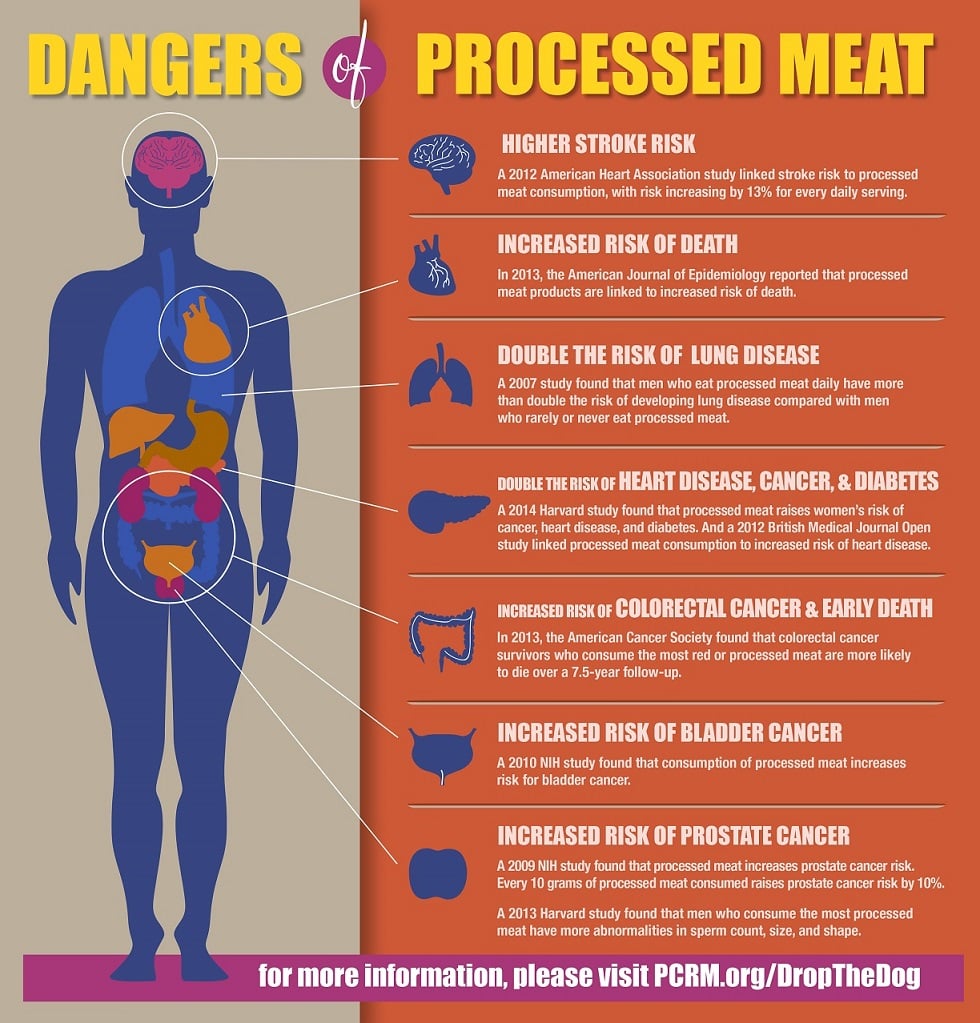
One statistic became the headline engine: IARC’s working group concluded that each 50g portion of processed meat eaten daily increases the risk of colorectal cancer by about 18%.
That sounds terrifying until you understand what kind of number it is. It’s a relative risk increase, not an automatic guarantee. The WHO-related discussion around this often emphasizes that, for any one person, the absolute risk increase remains small, though it grows as intake grows and as exposure accumulates over years.
This is why the public conversation gets messy. Relative risk is powerful for population health—small increases multiplied across millions of people can translate into many additional cases. But for individuals, it’s more useful to interpret it as: “This is a modifiable risk factor; less is safer.”
Why Processed Meat Might Raise Risk
The science isn’t just about meat as protein. The processing can change what’s present in the food and what forms during cooking and digestion. Processed meats are often linked to compounds such as nitrites/nitrates, and high-heat cooking can create additional chemicals that researchers study for carcinogenic potential. The WHO Q&A frames this as part of a broader evidence base that includes epidemiology and mechanistic understanding.
This doesn’t mean every slice is poison. It means that certain preservation methods and consumption patterns appear consistently tied to higher colorectal cancer risk in large observational data. And because processed meat is so widely consumed, the public health impact becomes significant even when individual risk changes are modest.
How the Media Framed It
The Guardian coverage in 2015 captured the shock factor: processed meats ranked among the substances classified as carcinogenic, alongside cigarettes and asbestos.
The phrasing was technically rooted in the IARC categories, but emotionally it landed like a direct equivalence. This is one reason the backlash was so intense. Food isn’t just nutrition; it’s culture, comfort, identity, and habit. When a breakfast plate gets pulled into the language of carcinogens, it feels personal—like an accusation.
Over time, the coverage evolved into more practical questions: How much is too much? What counts as processed? Is this about occasional consumption or daily intake? That second phase matters more for readers, because it replaces panic with decision-making.
What Health Guidance Actually Says

Public health guidance typically doesn’t say you must eliminate all processed meat forever. The emphasis is usually on reducing intake—especially if you eat it frequently. In the UK, the NHS advises that if you currently eat more than 90g per day (cooked weight) of red and processed meat, you should cut down to 70g.
That recommendation groups red and processed meat together, but many organizations note that the evidence for processed meat and bowel cancer risk is stronger than for unprocessed red meat. The practical takeaway is not “panic,” but “treat processed meat like an occasional food rather than a daily default.”
The Human Reality
If the science is widely known, why is processed meat still everywhere? Because it’s cheap, convenient, consistent, and culturally embedded. It’s the quick sandwich filling, the breakfast shortcut, the kids’ party platter, the road-trip snack. And it’s often positioned as “normal,” which is a powerful psychological force.
Risk reduction isn’t only about information. It’s about environment. When the easiest option is processed meat, people don’t need more lectures—they need better default choices. That could mean more appealing protein alternatives, better labeling, or reformulation. And that leads straight into a new wave of debate that has been building toward the 10-year anniversary of the 2015 classification.
A Decade Later, the Debate Shifted Toward Additives and Warnings
By 2025, discussion in the UK had increasingly focused on whether processed meats should carry stronger warnings and whether certain additives—like nitrites—should be reduced or phased out. News reporting highlighted calls for more aggressive public health measures and noted that products still commonly contain these preservatives.
This is the pattern with many health issues: first comes a classification, then comes public reaction, then comes the slow policy conversation about what to do with it. Some argue warnings are necessary for transparency. Others worry warnings oversimplify risk or stigmatize foods without context. Either way, the fact that the argument persists shows how enduring the 2015 decision has been.
What “Safer” Looks Like in Real Life
Reducing processed meat doesn’t require a personality change. It requires a few strategic swaps that keep life normal. If your default breakfast is bacon or sausage daily, shifting to a few days a week makes a meaningful difference over time. If your lunch is deli meat most days, rotating in eggs, fish, chicken cooked at home, beans, or tofu can reduce exposure without making you feel punished by your diet.
It also helps to separate “processed meat” from “protein.” People often hear the headline and panic that they must lose nutrients. But balanced diets offer many protein sources, and the goal is not protein fear—it’s lowering a specific, consistent risk factor.
The Ending That Matters: This Was Never Just About Bacon
The 2015 classification forced a modern dilemma into the open: what happens when a beloved, everyday product carries a measurable risk—even if that risk is not catastrophic for any one person? It creates a new kind of responsibility, not just for individuals choosing what to eat, but for industries, regulators, and health communicators deciding how honestly to talk about harm without triggering hysteria.
The deeper truth is that processed meat became a symbol of something bigger: modern convenience colliding with long-term health. And that collision doesn’t end with one announcement. It continues in supermarket aisles, in policy proposals, in reformulation debates, and in the quiet choices people make when they decide whether today’s meal is a daily habit—or just an occasional treat.